

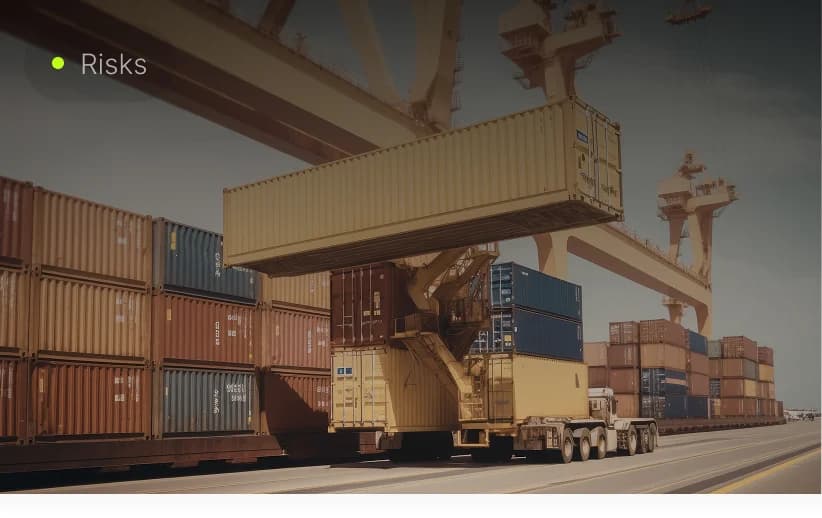
Incoterms for China imports: practical guide
The rule that defines who pays what and where your risk begins. The most used Incoterms when importing from China, explained to decide which suits your operation.
 J. Mauricio Mosquera
Incoterms in an import from China are the international rules defining, in a single code, who bears cost and risk on each transport leg. Published by the International Chamber of Commerce, they translate a complex agreement, where the seller's responsibility ends and the buyer's begins, into a three-letter code both parties read the same way. Choosing the right Incoterm is no formality: it determines how much you overpay, what risks you take and where you may lose control of your cargo.
This guide explains the most used Incoterms in trade with China, ordered from least to most supplier responsibility. It does not cover them all: it focuses on the four an importer meets in practice.
Incoterms® is a registered trademark of the International Chamber of Commerce (ICC). The current version is Incoterms® 2020; the codes and their scope are revised periodically, so always agree the version year in the contract. At PLT Logistic we work with the 2020 version when structuring each operation.
The question an Incoterm answers is simple: how far does the Chinese supplier's responsibility reach and where does yours begin? That cost-and-risk boundary is what each code defines.
EXW (Ex Works): maximum responsibility for the buyer
Under EXW, the supplier only makes goods available at its factory. From there, inland transport in China, export clearance, international freight and customs clearance are the importer's responsibility. It is the Incoterm giving the buyer most control, but also the most demanding: without an operator at origin, handling Chinese inland transport and export from outside the country is complex.
- The importer takes on pickup, inland transport and export from the factory door.
- It suits those with origin representation able to handle the Chinese leg.
FOB (Free On Board): the most common balance
Under FOB, the supplier delivers goods on board the ship at the Chinese port, with export already cleared. From that point, international freight, insurance and customs clearance are the importer's responsibility. It is the most used Incoterm in trade with China because it splits responsibilities clearly: the supplier controls its domestic leg and the importer controls the international one.
- The supplier covers inland transport and export clearance to the port.
- The importer controls international freight and chooses its freight forwarder.
- It is the recommended option for most first operations.
CIF (Cost, Insurance and Freight): the supplier books freight
Under CIF, the supplier pays freight and minimum insurance to the destination port. It seems convenient, but has a trade-off: the importer loses control over carrier and freight forwarder choice, and the contracted insurance is usually minimum cover. CIF applies to ocean transport only.
Choosing CIF for convenience and discovering inflated carrier charges and minimum-cover insurance at destination. In practice, when the supplier controls the freight it also decides who is billed for local charges, and the importer pays them without having negotiated them.
- The supplier books freight and insurance to the destination port.
- The importer cedes logistics control and takes on clearance at destination.
DDP (Delivered Duty Paid): the supplier delivers everything settled
Under DDP, the supplier delivers goods at the agreed destination with everything paid: freight, insurance, duties and import taxes. It is the Incoterm of maximum seller responsibility. For the importer it is convenient, but demands full trust that the supplier handles clearance correctly in a country that is not its own, which in practice creates opacity over costs and taxes.
- The supplier takes on clearance and final delivery at destination.
- The importer gains convenience but loses visibility over real costs.
Quick comparison and how to choose
| Incoterm | Supplier covers to... | Ideal for... |
|---|---|---|
| EXW | Factory door | Importers with an operator at origin in China. |
| FOB | On board | Most operations and control of freight. |
| CIF | Destination port | Those prioritising convenience over logistics control. |
| DDP | Final delivery | Those wanting everything settled and accepting less visibility. |
FOB is the most balanced starting point to import from China: the supplier delivers at the port and the importer keeps control of freight and the logistics operator.
Frequently asked questions
How PLT Logistic helps with the Incoterm choice
PLT Logistic advises on the most suitable Incoterm by operation and, based in Guangzhou since 2018, executes the origin leg each term requires. Under EXW we handle inland transport and export. Under FOB we coordinate port delivery, Yantian, Nansha or Shenzhen, and international freight. The importer chooses the Incoterm with an operator able to fulfil it at origin.
Not sure which Incoterm to agree with your supplier in China?
PLT Logistic advises on the Incoterm for your operation and executes the origin leg each term requires.
No commitment · Free logistics assessment · Response within 24h
This article is written and reviewed by the operations team at PLT Logistic, a logistics operator with a physical base in Guangzhou (Baiyun district), China, since 2018. We coordinate freight forwarding, origin logistics, pre-shipment inspections and business representation in Mandarin every day for importers across Spain and Latin America.
Operational review: J. Mauricio Mosquera · Guangzhou, Guangdong · Last reviewed: 8 June 2026
You may also find this useful
 FREIGHT FORWARDING
FCL vs LCL: when to use each and how to decide
Operational differences between full-container and consolidated freight, the CBM break-even point, and when each mode reduces cost and risk more effectively.
 FREIGHT FORWARDING
Freight forwarder vs customs broker: key differences
What each figure does, where responsibility starts and ends, and why importers usually need both so transport and customs clearance work together.
 MARKETS & ROUTES
How to import from China to Colombia: step-by-step guide 2026
Operational summary of the full process: supplier, origin control, international freight and DIAN customs clearance for China-to-Colombia imports.