

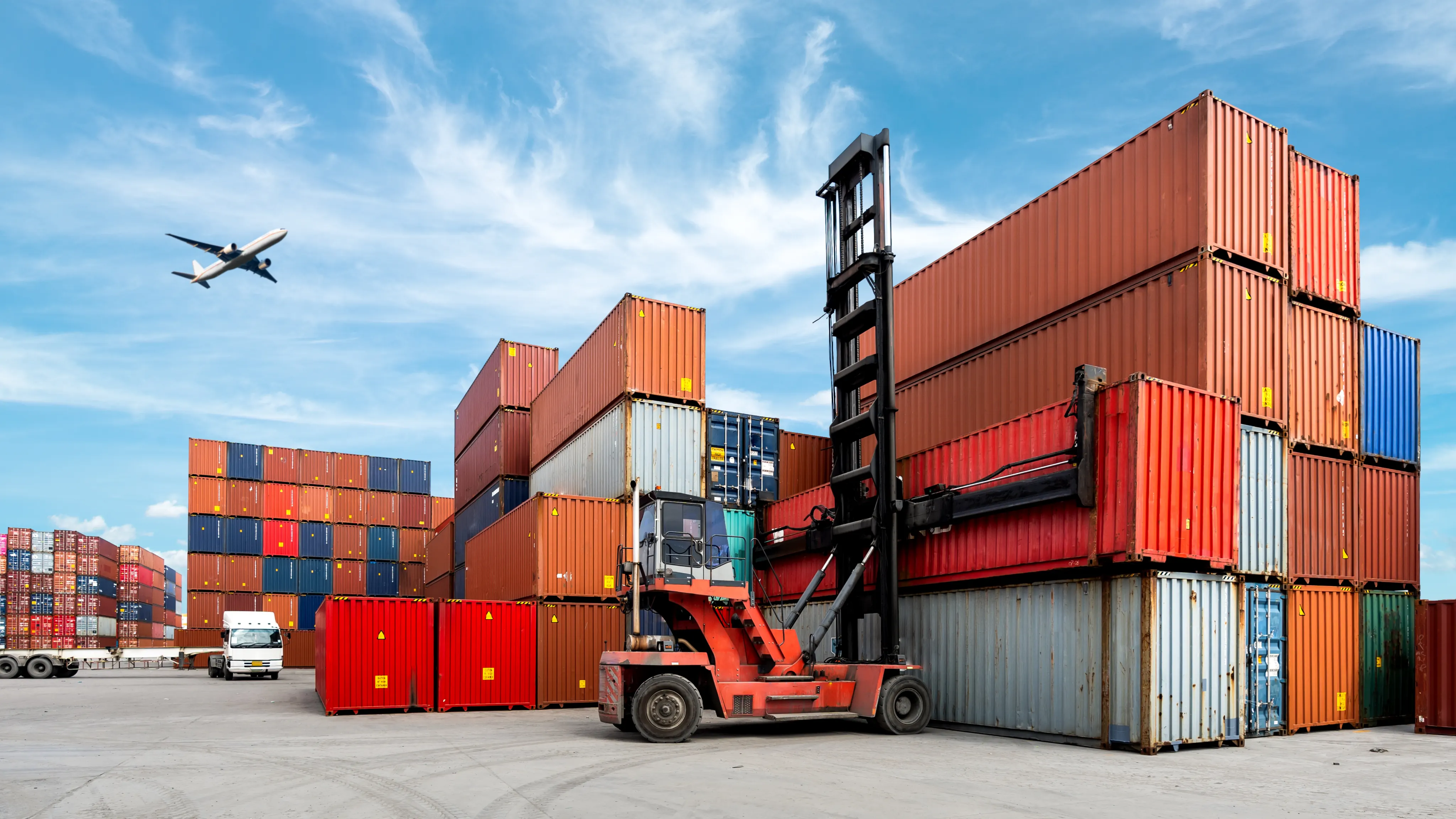
FCL vs LCL: when to use each and how to decide
The decision that defines the cost and safety of your ocean freight: when a full container makes sense, when consolidated cargo does, and how to find the break-even point.
 J. Mauricio Mosquera
Choosing between FCL vs LCL is one of the first technical decisions in ocean freight from China, and one with the biggest impact on cost per unit. FCL (Full Container Load) means contracting a full container for your exclusive cargo. LCL (Less than Container Load) means sharing a container with other importers' goods, paying only for the volume you occupy. There is no better option in the abstract: the right one depends on your cargo's volume, value, fragility and urgency.
Understanding the difference avoids two costly mistakes: paying for a half-full container, or consolidating cargo so large that fragmentation ends up costing more than an FCL.
The calculation turns on volume in cubic metres (CBM). Above a certain volume, the full container usually costs less per CBM than consolidated cargo.
What FCL is and when it makes sense
In FCL, a 20- or 40-foot container travels with your exclusive cargo, sealed at origin and opened at destination. The rate is per container, not per volume, so cost per CBM falls the fuller it gets.
- It makes sense when volume approaches or exceeds the usable capacity of a 20-foot container, roughly 28 to 33 CBM depending on cargo.
- It reduces handling: goods are not opened or mixed with third parties', lowering the risk of damage and loss.
- It usually means less terminal time because it requires no deconsolidation at destination.
What LCL is and when it makes sense
In LCL, your cargo is consolidated with other importers' in one container. You pay for the volume you occupy, calculated in CBM, with a billable minimum. It is the natural route for small volumes.
LCL hides costs the first-time importer does not always budget for: deconsolidation at destination, handling charges and more exposure to cargo handling. Comparing only freight per CBM often leads to the wrong decision.
- It makes sense for cargo that does not fill a container: from 1 CBM up to medium volumes that still do not justify an FCL.
- It allows importing with lower upfront investment and testing product or supplier without committing to a full container's cost.
- It involves deconsolidation at destination, adding handling and sometimes a few days of terminal transit.
FCL vs LCL: direct comparison
| Criterion | FCL | LCL |
|---|---|---|
| Rate basis | Per container. | Per volume (CBM), with billable minimum. |
| Ideal volume | High: near or above a container. | Low or medium: does not fill a container. |
| Handling | Minimal: sealed cargo, no mixing. | Higher: consolidation and deconsolidation. |
| Damage risk | Lower. | Higher due to extra handling. |
| Terminal time | Generally lower. | May add days for deconsolidation. |
How to decide: the break-even point
The practical rule is to compare the total LCL cost of the cargo against the cost of a full container. As volume grows, the accumulated LCL cost approaches an FCL's until it crosses it. That crossing is the break-even point.
As an operational reference, many importers find break-even when LCL already represents 13 to 15 CBM or more. Below that, LCL is usually more efficient; above it, a 20-foot container is worth evaluating. Cargo value and fragility tip the decision toward FCL even before pure cost break-even, because they reduce handling.
Fragile or high-value cargo may justify an FCL even when the CBM calculation suggests LCL: less handling means less risk of damage, claims and delay.
Common mistakes when choosing a mode
Booking FCL with half-full cargo
You pay for unused capacity and push unit cost artificially high.
Forcing LCL on a high volume
The sum of CBM, deconsolidation and handling ends up exceeding the cost of a full container.
Ignoring destination deconsolidation
In LCL, terminal time and cost need to be in the calculation from the start.
Frequently asked questions
How PLT Logistic coordinates freight from China
PLT Logistic evaluates each order to recommend the most efficient mode and coordinates freight from China in both formats. We operate from Guangzhou since 2018: we consolidate LCL cargo in our origin warehouse when convenient, book FCL with carriers from Yantian, Nansha or Shenzhen and control transport documentation so the importer pays for the right option, not the most expensive one.
Not sure whether your cargo should ship as FCL or LCL?
PLT Logistic evaluates your cargo's volume, value and urgency and coordinates freight from China in the most efficient mode.
No commitment · Free logistics assessment · Response within 24h
This article is written and reviewed by the operations team at PLT Logistic, a logistics operator with a physical base in Guangzhou (Baiyun district), China, since 2018. We coordinate freight forwarding, origin logistics, pre-shipment inspections and business representation in Mandarin every day for importers across Spain and Latin America.
Operational review: J. Mauricio Mosquera · Guangzhou, Guangdong · Last reviewed: 23 June 2026
You may also find this useful
 FREIGHT FORWARDING
Freight forwarder vs customs broker: key differences
What each figure does, where responsibility starts and ends, and why importers usually need both so transport and customs clearance work together.
 MARKETS & ROUTES
How to import from China to Colombia: step-by-step guide 2026
Operational summary of the full process: supplier, origin control, international freight and DIAN customs clearance for China-to-Colombia imports.
 SUPPLIERS & SOURCING
What is a buying agent in China and when do you need one
What a buying agent does, how it controls supplier and goods at origin, and how it differs from the freight forwarder within a China import operation.